The most important building in Islamic Spain and other centers of Muslim civilization is the mosque (called in Arabic masjid), a house of worship. Mosques are almost completely empty inside, without seats or altars. The empty space is a surface for decoration and expression of form.
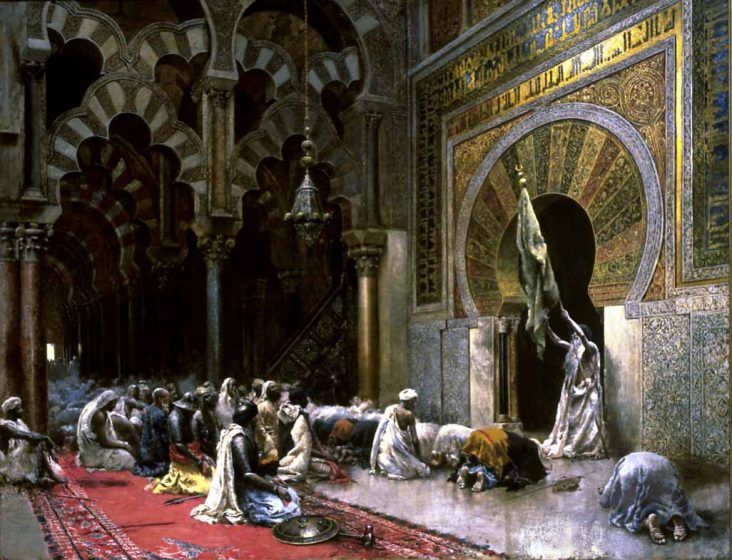
All mosques are modeled upon the Prophet’s Mosque in Madinat al Nabi (a city near Mecca, in today’s Saudi Arabia). It was a simple rectangular building with a mihrab, or prayer niche, to show the direction to face during worship. It had columns made of date palm trunks, and a thatched roof held up by palm trunks. The person who called the prayer, the muezzin, climbed to the roof so he could be heard in the neighborhood of the mosque.
Virtually all other mosques have these same features: a prayer hall, a mihrab, and a minaret, a tower the muezzin climbs to project his voice in the call to prayer. Beyond these common characteristics, however, mosques are as varied as the lands and the Muslims living around the world.
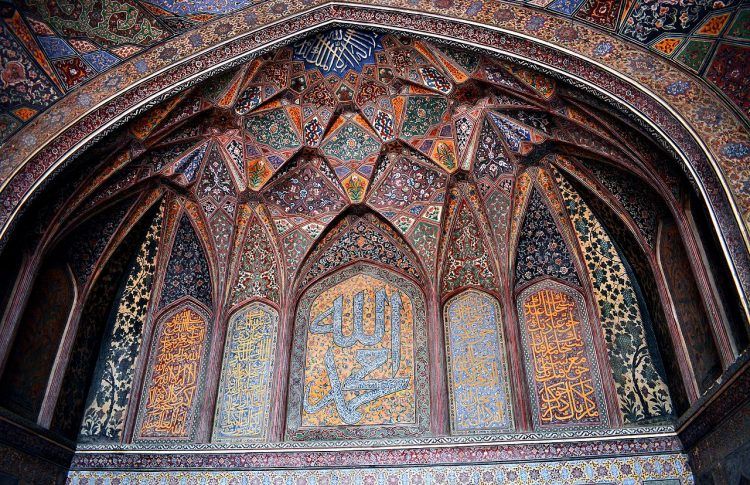
Their decoration is equally varied, from plain earthen or white-plastered walls, to fabulously carved and tiled geometric designs. None of these designs — nor any other feature of the mosque — depicts an animal or human being, which might suggest worship of any other being but God. Calligraphy, or beautiful writing from the Qur’an, Islam’s holy book, can be found in many mosques as part of the decoration on walls, arches, domes and tiles.
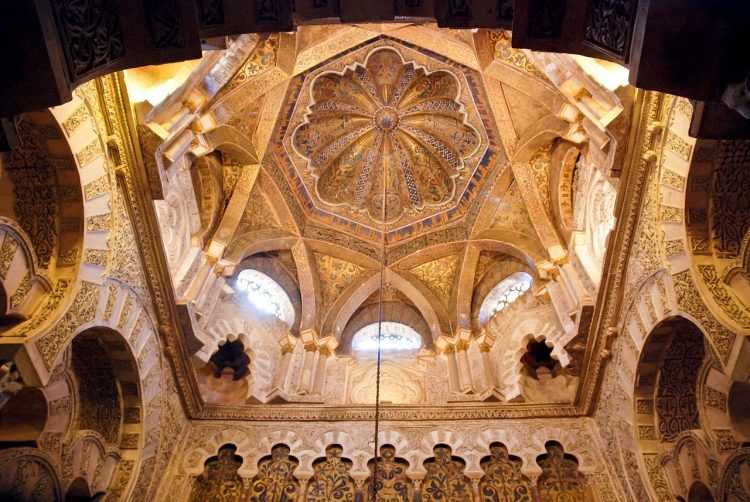
The Great Mosque of Córdoba was designed under Abd al-Rahman I. It began construction in 787 CE, then expanded under later rulers. The building was innovative. The double horseshoe-shaped arches added height and drama to the prayer space, especially with their red-and-white striped decoration on top of simple columns.
Using color in architecture was a design element that traveled widely under Andalusian influence. In 961 CE, a special section of the mosque added “poly-lobed” arches with carved decoration, meaning that the arch was scalloped. The ribbed dome of the mosque gave it strength, but also formed a star pattern that highlights the mosaic designs in the center and between the ribs. The architectural features in the Córdoba mosque spread to other forms of architecture and became visual symbols of Al-Andalus. The ribbed vault design became a familiar feature in gothic cathedrals of northern Europe.
The minaret is another Islamic form that found many applications in other places, from bell towers in Europe to skyscrapers in the 20th century. Minarets can be very solid, like those built using adobe brick, which have a narrow pyramid shape, or they can be very thin like Ottoman period minarets. In Spain and Morocco, brick towers with a square footprint graced the rectangular mosque layout. The minaret rose to a great height and featured geometric patterns in brick, and symmetrical openings near the slender top.
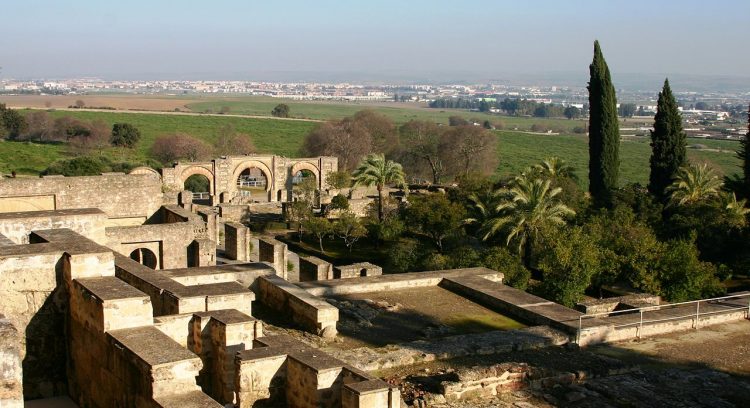
Palaces for Andalusian rulers were legendary for their influence in the West for centuries to come. Madinat al-Zahra was the first palace to be built in Al-Andalus. Built during the rule of Abd al-Rahman III (961-976 CE), it was a complex of buildings on terraces, and composed of indoor and outdoor spaces intermingled with gardens, pools, fountains, and surrounded by walls. Its walls and pillars were decorated with carving and tilework, and it was filled with fine furniture and decorative pieces made by the best craftsmen. It was a wonder to those who visited it and carried away stories of its grandeur. Madinat al-Zahra was destroyed in 1010 CE during a civil war, and it still remains for archaeologists to learn from its ruins.
The second most famous palace was built by the Nasrid rulers of Granada during the 13th century or earlier. It shows the influence of the North African dynasties that ruled in Spain, and brought important ideas in architecture with them. One of these ideas is the decorative muqarnas, plaster stalactites that break up the solidity of domes and arches, placed in geometric patterns and surrounded by carved plaster, calligraphy and tilework. The Alhambra is also a complex of indoor and outdoor spaces that flow into one another, with pools and gardens. The Alhambra has been celebrated by poets, travelers, and artists since it was built.
There are many other architectural monuments in Spain that show the skill and artistic splendor of Andalusian architecture. Cities such as Toledo, Valencia, Almeria, Seville, and others have mosques, bridges, public works, and homes in the Andalusian style. This style also traveled to the New World with the Spanish and Portuguese colonies, and spread to the southwestern United States.