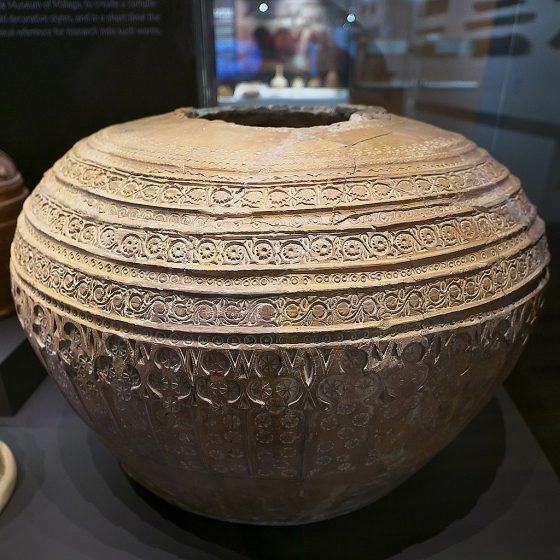
The Iberian Peninsula has produced pottery from Neolithic and Roman times to the present. The tradition continued in Al-Andalus, where tiled walls, floors, and buildings of all kinds became typical features of the built landscape. The ceramics produced in Islamic Spain became famous throughout the Mediterranean.
Pottery is made from different types of natural clay or earth, and glazes are made from minerals mixed with sand, which melt at high temperatures to form a waterproof, colorful seal on the pottery. Its distinctive style comes from its shape, color, and decoration. Andalusian ceramic artisans developed many styles and techniques that have strongly influenced ceramic production around the world — probably in your own bath or kitchen.
Production of fine ceramics during Medieval times was a technology that involved the whole continent of Eurasia. The intense network of Muslim trade routes in the eastern hemisphere contributed to the spread of techniques through trade over land and sea.
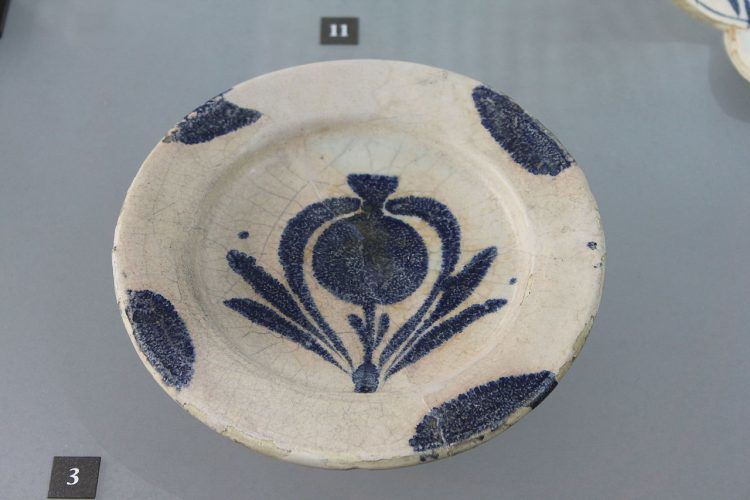
In early Muslim Iraq, for example, a new type of pottery was made that eventually spread to China, where it became one of the most famous types of ceramic ever made. In Iraq, light brown clay was covered with a white, opaque glaze made from tin. On top of the white glaze, cobalt was painted to make blue designs when fired in the kiln. Arabic lettering, geometric designs and animals were popular on these dishes.
Use of cobalt blue glaze spread along the Silk Roads to China, where it was applied not to brown clay, but to the pure white, thin, bone-hard porcelain that was China’s secret. Blue-and-white porcelain was born, and became wildly popular as an export item in east and west. It is still imitated today. Designs for blue-and-white wares included Chinese motifs like clouds and fish scales, and Islamic motifs like arabesques and geometric patterns. Blue-and-white cobalt and tin-glazed ceramics spread to the Mediterranean area, including Al-Andalus.
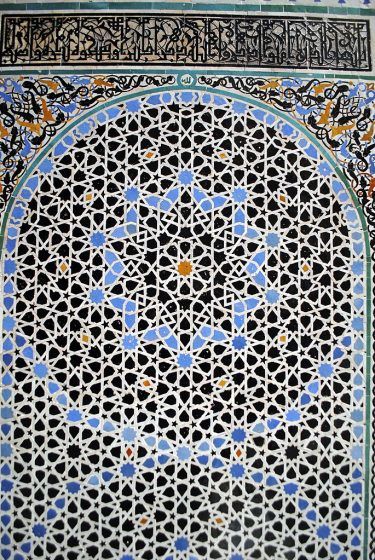
Central Asian shaped tile patterns and textures also contributed to the fund of ceramic designs and technologies. Walls, floors, and domes were covered with a surface of shaped, cut tiles to form a mosaic surface like the one at left. This technique came to North Africa and Al-Andalus as zellige work.
A technique called cuerda seca, or “dry cord,” involved drawing the design on fired clay with a crayon made of the mineral manganese mixed with wax or oil. Between these crayoned lines, different colors of glaze could be painted to create a mosaic effect, and the colors would not run together during firing. This was more economical than the method of cutting tiles glazed in different colors into shapes like the one at left. With the cuerda seca technique shown at right, red, green, brown, yellow, and blue glazes could be combined on one object, painted, and glazed in one firing. This technique allowed freedom of design that eventually influenced majolica ware, with its colorful designs in Spain, and later in Italy.
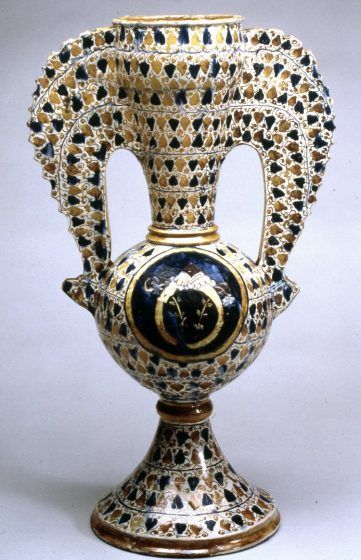
Another important technique used in the ceramics of Islamic Spain was lusterware. White, tin-glazed pottery was painted with a metallic overglaze, sometimes together with cobalt blue for contrast, and fired again. This was a difficult and very expensive technique whose pieces were treasured by the wealthy and found their way into palaces like the famous Alhambra in Granada. One Andalusian center of lusterware production was Valencia, which continued to produce objects for wealthy families of Renaissance Italy like the Medici, in the 15th century. Wedding vases with the family coat of arms like the one at right, medicine jars for apothecaries and hospitals, and plates for banquets were among these valuable pieces.
Mudejar ceramic artisans continued to work after they came under Christian rule, and their styles and techniques persisted during the following centuries. One of the legacies of intolerance was the expulsion in the 16th century of some artisan families, and along with it, the turn away from the long tradition of Arabic and Islamic techniques and styles, as well as the denial of their contribution. Scholars, artisans, and historians today are working to recover the truth of that cultural heritage.
Learn more about the ceramics of Islamic Spain here.