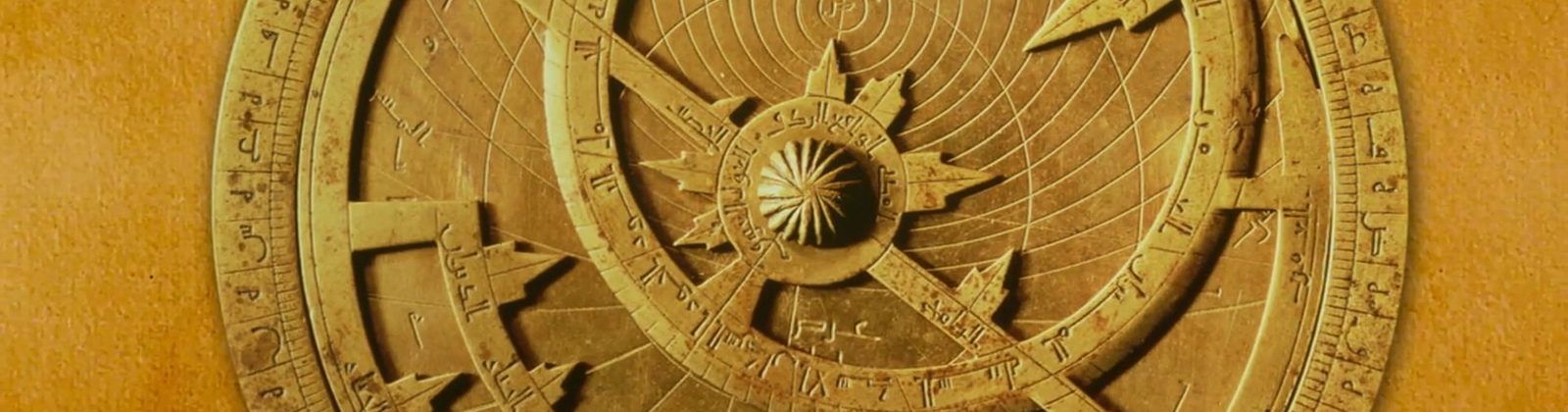
Muslim civilization developed at a time in human history when numerous large territorial empires had been established in various parts of Afroeurasia. Long-distance trade, the spread of religions, and extensive recording of knowledge in writing had preserved a legacy of human ideas.
Major civilizations had advanced disciplines such as astronomy and mathematics, and philosophical as well as ethical systems of thought had begun to explore theories of knowledge. Human inventiveness had solved many challenges such as how to irrigate dry land and store water, work with metals, work with fibers and other natural fabrics, and to preserve food. The expansion of territory under Muslim rule, and the expansion of trade and economic growth in general, brought many peoples and places into contact. Historians say that from the 8th to the 15th centuries, human networks of exchange expanded and intensified.
In order to increase trade and expand the economy, production of many goods and natural resources had to be increased. Construction of cities, roads, ports, dams, and bridges required planning and engineering. Muslim engineers were able to draw on the ideas already built up by earlier societies’ efforts. They combined these ideas with new mathematical knowledge and tools to create machines, instruments and construction techniques that advanced human skill and knowledge. From China, Central Asia and India in the east, to Al-Andalus and North Africa in the far west, the ideas and knowledge of technology was able to circulate. Libraries were built to house books on these subjects, artisans were commissioned to travel where their skills were needed, and news of the latest ideas spread.
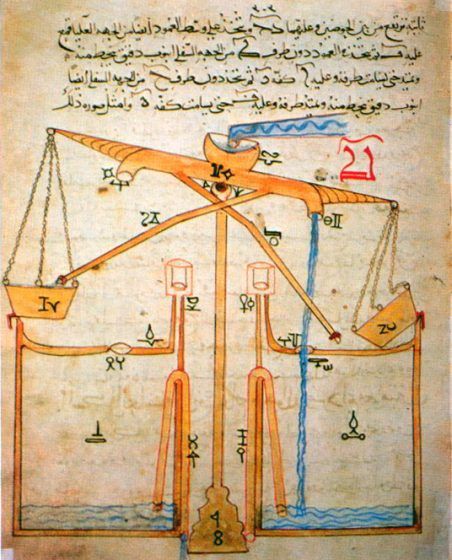
The brothers Banu Musa bin Shakir (ca. 850 CE) were inventors and engineers from the eastern Muslim lands. They translated and wrote over 20 books on engineering. They described about a hundred useful mechanical devices in Kitab al-Hiyal (The Book of Ingenious Devices). Their work seems to reflect knowledge of the Alexandrian Hellenistic tradition of mechanics, since they translated important works of Hero, and Philo of the 3rd century, into Arabic. Some of the Banu Musa bin Shakir’s devices are similar to those earlier technologies, but others go far beyond them.
In engineering, there are certain mechanical components, or parts of machines, that have many uses. Examples of these components are: a device that controls the flow of liquids by opening and closing in a cycle, crankshafts and gears that transfer energy or regulate the speed and movement of the machine, a ratchet that stops the movement of gears in a certain direction, and parts that multiply the force of the machine. Some of these important milestones in engineering that are found in Kitab al-Hiyal are shown for the first time in the history of technology. Some of them would not be seen in engineering works until 500-1000 years later in modern industry.
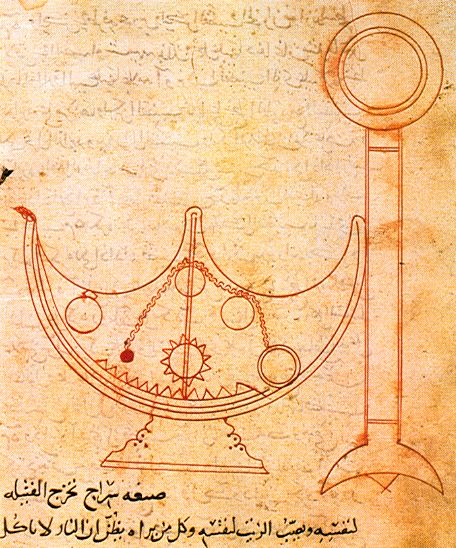
Al-Muradi of Andalusia was an 11th century CE scientist who wrote The Book of Secrets about the Result of Thoughts, which contains the earliest description in Arabic of water clocks and other mechanical devices called automata. The book contains 31 models run by water wheels that regulate the intensity of flowing water. Nineteen of the devices are clocks. They use a component called a clepsydras, and the figures (often human or animal) ran by means of elaborate gear systems, lubricated by mercury. These innovations were not seen again in any society until the 13th century CE, when they were used in European clocks. At the court of Alfonso of Castile in about 1277 CE, a Spanish book, Libros del Saber, contained translations and summaries from Arabic sources. Al-Zarqali must have had access to this knowledge when he built two large water clocks in Toledo in the 11th century CE. Other components used in water clocks were siphons (small tubes that flow by gravity), and float valve devices, similar to the valve in household toilets and sump pumps that turn the device off or on with the water level.
The 13th century work of al-Jazari, which was published with drawings that engineers can use today to re-create these machines, helped solve mechanical problems by creating components that were later used in steam and gasoline engines. Escapements, another important mechanism developed by al-Jazari and used in Spain, are important for timing the movements of machines. They were used in automata (self-moving machines) that featured as curiosities in the palaces of Medieval Muslim rulers, but which were important for the development of serious mechanical devices; they showed off the society’s technical abilities.
Another form of engineering is seen in public works and buildings. Constructing a heavy stone or wooden structure that does work and lasts a long time requires engineering knowledge of the first order. The accumulated knowledge of architecture involves knowing how to distribute the weight of building parts like roofs, walls, and towers so that they do not collapse. Arches that open a building must carry its weight downward, and towers must have carefully calculated foundations and wind resistance to keep them from sinking into the earth, leaning, or falling over. Dams that hold back rivers’ floodwaters are built straight or curved according to exact mathematical proportions, and they need gates that control the flow of water.
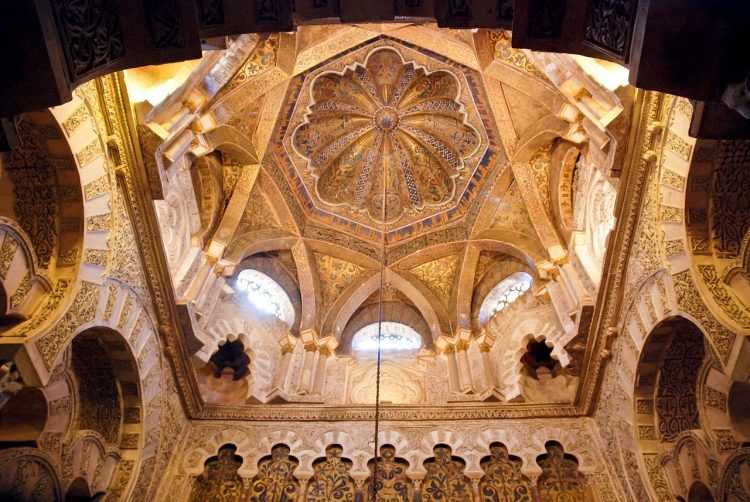
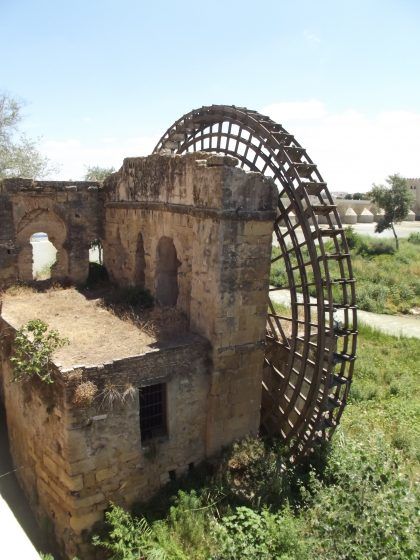
In Spain, Roman construction of aqueducts was maintained under Muslim rule, and complex irrigation, drinking water, and flood control systems were built on Spain’s many rivers. The oldest dam constructed by Muslims is at Córdoba, a long, zig-zag shaped wall about 8 feet above the high-water mark and eight feet thick. To figure out where to place the dams, surveying with instruments like astrolabes and calculations using advanced mathematics like geometry and trigonometry were necessary.
The dams were engineered from stone and cement by mixing sand and water with ashes and baked lime to make it harder than stone against cracking. One writer states that “these dams needed hardly any repair in a thousand years.” The design had to be suited both to the vertical drop of the river, the energy of its flow, and the softness or hardness of the riverbed. Each was differently engineered. In addition, the dams were placed so that water power could be used to run waterwheels linked to machines for grinding grain, pounding pulp and paper, raising water, and other heavy labor.