The story of glass-making involves many centuries and many peoples, over thousands of years. It is not always possible to discover the exact origins of specific techniques. A legend with origins in 7th century Spain, in the writings of Isidore of Seville, describes its invention as a historical accident by Phoenician merchants:
… in a part of Syria which is called Phoenicia, there is a swamp…from which the Bellus River arises . . . whose sands are purified from contamination by the torrent’s flow. The story is that here a ship of natron [sodium carbonate] merchants had been shipwrecked; when they were scattered about on the shore preparing food and no stones were at hand for propping up their pots, they brought lumps of natron from the ship. The sand of the shore became mixed with the burning natron and translucent streams of a new liquid flowed forth: and this was the origin of glass.”
~ Isidore of Seville, Etymologies XVI.16. Translation by Charles Witke
According to archaeologists, however, true glass originated in Mesopotamia in about 2500 BCE, where beads, seals, and glazed decoration on buildings have been found. About a thousand years later, glass artisans learned how to make glass containers, and the technology spread to Egypt and Greece. Perhaps Isidore of Seville thought Syria and Palestine were the source, because the major glassmaking center of his time was there, and in Egypt. Isidore could not have known that his own homeland would become a center for skilled glassmaking just a century or two after he lived, when the area came under Muslim rule as Al-Andalus.
Glass is a mixture of sand, soda, and lime melted together in a very hot furnace. Colored glass can be made by adding metal oxides to the glass (rust, for example, is iron oxide.) Metal compounds that make beautiful colors are cobalt for dark blue, iron for green, tin for opaque white, antimony and manganese for colorless glass, and many others. These formulas were closely guarded secrets among glassmakers, but some scientists, such as the Muslim writer al-Biruni (d. 1048 CE), recorded this kind of information.
There are several ways to make glass containers. The earliest technique was to form it by winding hot glass around a clay core. After cooling, the core was removed and the glass polished with sand. Later, artisans learned to make containers by pouring fused glass into a clay mold, then polishing and grinding it. Around 50 BCE, glass-blowing was invented. A blob of glass heated in a furnace was placed on the end of an iron pipe, and the artisan blew into it, forming a bubble of glass. This achievement happened in the area of Syria and Palestine. Beautiful glass objects could now be formed into large or tiny bottles, pitchers, and vases. Hot glass trails and dots were added to the surface to make handles and other decorations.
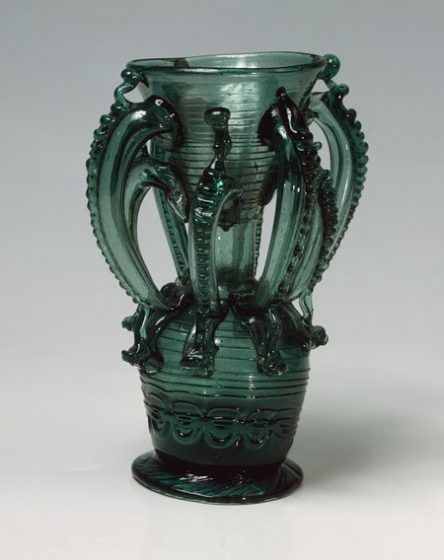
The Romans, Egyptians, and Persians used this technique, and it was transmitted to the Arabs and carried to Spain. In cities of Al-Andalus like Almeria, Murcia, and Malaga, artisans made delicate glassware like this 8-handled green glass bottle from Almeria, which is in the Hermitage Museum at Leningrad along with almost 100 other glass objects from southern Spain that are made in the Islamic tradition. Experts say that this region kept strong connections with Syrian glass-making centers. Syrian and Andalusian glass also influenced Italian glass-makers at Murano, who made pilgrim flasks and large glass vases similar to enameled mosque lamps.
Colored glass windows, and especially the spectacular stained-glass windows in cathedrals, have a long and uncertain history. Like other glass technologies, there is most likely more than one line tracing its origins. We know that the Romans made glass into windows during the first century CE. This glass let in light, but it was very thick and not transparent. They may have done this in the colder, northern cities of their European empire, because the technology seems to have survived into the early middle ages. Archaeologists have found pieces of colored glass used in a window in a monastery founded in 686 CE in England. Other European locations of Roman glass-making have also been found.
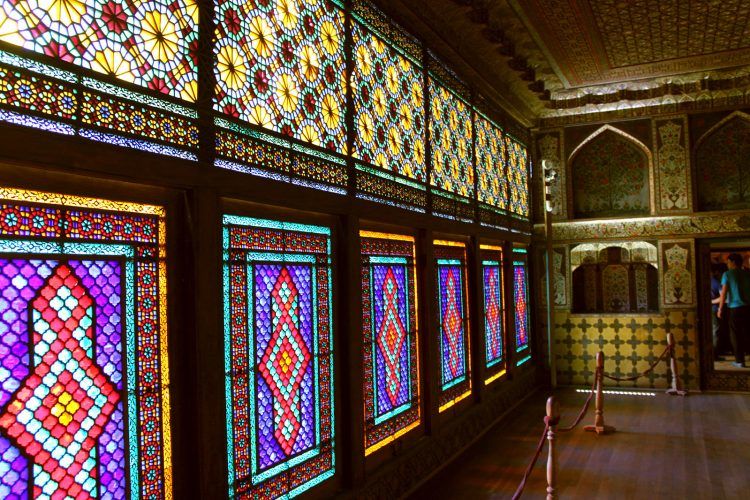
The idea of using colored glass to create geometric and floral designs also has multiple origins. In 1937, in Syria, archaeologists named Jean LaFond and David Schlumberger discovered an 8th century Islamic city in the desert near Palmyra.
They found 115 colored glass fragments in colors like “greenish white, bluish white, moss green … tobacco yellows … burnt sienna, smokey, three purples (one near wine, one more brown), a garnet [red] of great beauty and two violet purples …” Schlumberger found evidence that they had been mounted in a framework of stucco in arabesque designs, so that light would show through the glass. This technique has also been found in Yemen, where instead of glass, thin pieces of alabaster let a golden light through the design into the room between the stucco. Here, in an 8th century Umayyad city, was an early stained-glass window.
Experts believe that Arabian “filigree” windows moved into Europe when the Muslims entered Spain, and that these windows were cemented into marble, plaster, or stone, with iron ribs used to make the windows stronger. These early stained-glass window designs may have appeared there as early as the 10th century, or as late as the 13th century.
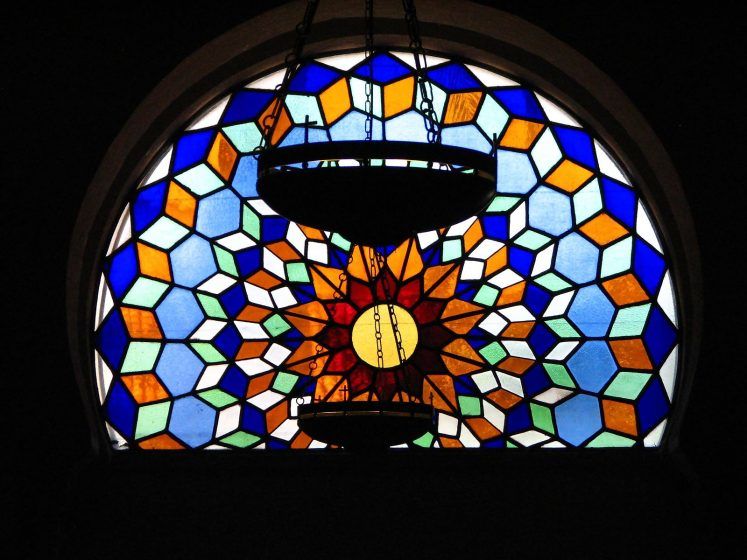
Colored glass mosaics had appeared in Spain, imported by Byzantine architects building the mosque of Córdoba, in the 10th century. The technology was certainly present for making colored ceramic glazes, which use many of the same substances, and glaze for pottery is also a kind of glass.
In northern Europe, development of stained glass may have another thread of origin based on Romanesque ideas and techniques, which were also linked to Rome and Syria through the Byzantines. These windows at first had no glass in the decorative openings, but were pierced openings in slabs of lead. Later, small pieces of glass were attached using soldered strings of lead. Romanesque Christian churches built in the 4th and 5th century also have windows that use patterns of thinly-sliced alabaster in wooden frames, like those of Yemen.
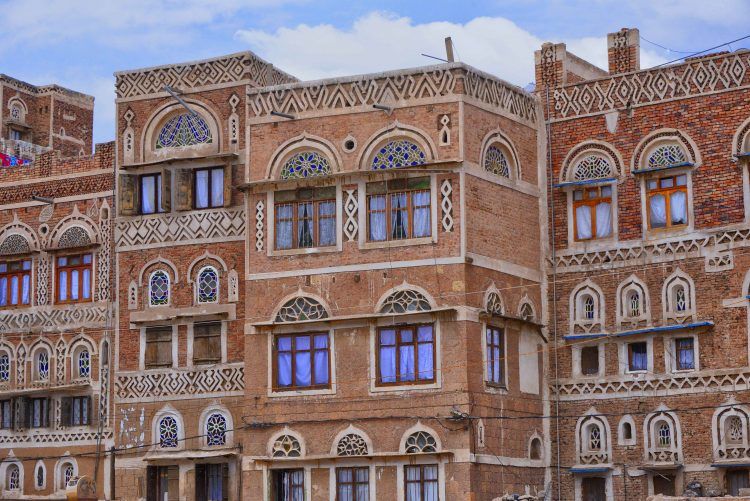
European and Islamic window designs seem at first very different. Muslim artists did not use pictures in mosques. European stained glass in churches tells stories from the Bible and shows pictures of Jesus, Mary, the Apostles, and saints. Examples of painted glass in Europe that may have been used in a window date from 540 CE and 1000 CE , in Italy. As European stained glass artistry reached its height, however, it combined designs using human figures with highly complex geometric designs reminiscent of Islamic art and mathematical skill. Whether or not the ideas can be traced to common origins, there are surely many remarkable connections in space and time.
It is probably no coincidence that European glassmaking and Gothic cathedrals both advanced during the time of the Crusades and after, and that the 12th century was a time of growth in towns and trade in Europe, following centuries of urbanization in Muslim lands. This was also a time when scientific knowledge entered northern Europe from Islamic Spain and Sicily, and when cultural influences came from Spain and from the returning Crusaders. It is widely known that cathedrals owe many architectural and engineering techniques to advances from Muslim lands, such as the pointed arches and vaults that can be traced to North Africa and Al-Andalus.
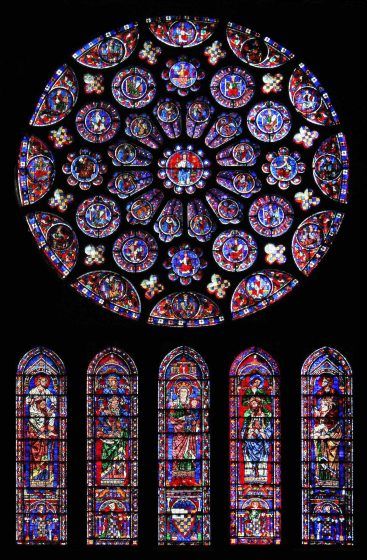
Chartres Cathedral (built 1134-1220 CE) has a beautiful rose window that combines the techniques of leaded stained glass with geometric designs that are very complex, and based on the circle. The designs are set into openings in the stone, perhaps suggesting the stucco or marble designs of Spain or Syria. German art historian Otto von Simson explained the origin of the rose window by comparing the idea to the six-sided rosettes and octagon window on the outside wall of the Umayyad palace Khirbat al-Mafjar, built in the Holy Land in about 750 CE. The theory is that Crusaders saw such windows and brought the idea back to Europe, introducing it into churches.
Is it just a coincidence that many techniques and knowledge, and contact among peoples all intensified at this time? Is it possible that beauty and skill are the result of many hands, minds, and lands—sometimes through conscious contact and sometimes indirect? Some day, perhaps we shall know more.