It is widely thought that music is forbidden in Islam. Scholars cite hadith, or sayings of the Prophet Muhammad, to state that certain types of music distract from worship, and that music is a source of temptation that leads to committing other excesses and sins. Others, however, cite hadith showing that the Prophet Muhammad did permit singing, as long as the purpose of the song itself is beneficial, and the words used in the song fall within the range of permitted speech.
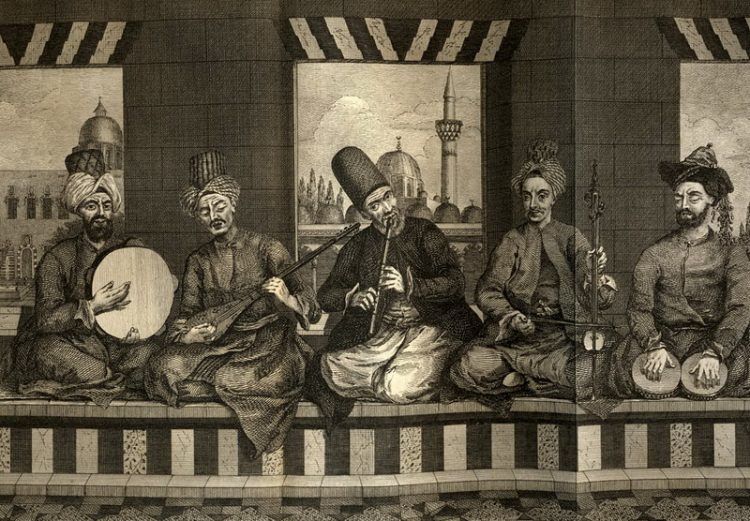
Songs that are neither defamatory nor incite one to sin, that are sung to accompany work that stir the audience to remembrance and unity are permitted. According to this interpretation, Islamic practice recognizes the elemental human affinity for rhythmic speech and melody. There is also wide agreement that use of the drum to enhance and lead the rhythm of song is permitted.
Music offers an interesting example of the intersections and differences between religious beliefs and culture in Muslim societies. Whatever religious scholars may have said about musical expression, every cultural and ethnic group now counted among the Muslims of the world has its musical traditions and expressions.
These traditions have been adapted to Islamic ideals, incorporating spiritual ideas and celebrating Islamic themes. They have become part of Islamic rites of passage and events such as marriages, births, and festivals. Many groups have brought their native musical instruments into the culture and retained them, as well as passing them on to others. Drums and other rhythm instruments, plucked and bowed stringed instruments, and horns and flutes, are found among the musical traditions and folk arts of Muslim peoples. The common thread of the art of the human voice runs through Arabic and other languages such as Persian, Turkish, Urdu, and hundreds of other Asian, African, and European languages.
Both the Islamic call to prayer and the art of reciting the Qur’an have influenced artistic expression in Muslim culture. Islamic worship incorporates a form of music into worship, but not in the same way as Christian choral or organ music, for example. The call to prayer is an art form that utilizes tonal variation and rhythm in the human voice.
Recitation of the Qur’an beautifies the words through tone, rhythm, and the shaping of the words. The living Qur’an is not only or primarily the written word. The Qur’an is first of all the recited word of God — sounded with perfection and beauty that equals the most magnificent calligraphy. There are numerous styles of recitation that trace their origin to the teaching of Muhammad, in a direct line to the present, passed down the ages through many masters.
Arabic poetry is a tradition related to music and song. It began in pre-Islamic times and continued after the coming of Islam, drawing upon the themes and forms of centuries of pre-Islamic poetry. During the first centuries of Islam, poetry was the major art form, which spread with the expansion of the Arabic language into the new lands under Muslim rule. Poetry was the basis of song traditions in Arabic that were influenced by contact with many cultural traditions and had a great influence on them that is still felt today.
As the Arabs came into contact with other cultural influences through expansion and conversion of new Muslims, various traditions of music, musical instruments, and rhythmic forms blended into the mix of Muslim culture. Literate and scholarly traditions expanded beyond the religious disciplines, coming into contact with the high cultures of Persia, India, and Byzantium, as wel as the Greek heritage.
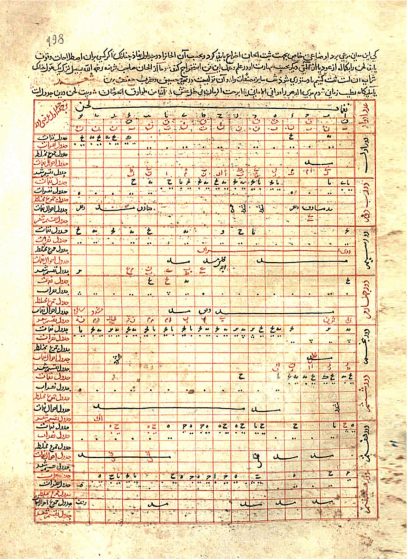
The Abbasid translation effort brought exposure to mathematics and philosophy, which included ideas about music theory, through the translation of Greek works that treated music theory as a branch of mathematics.
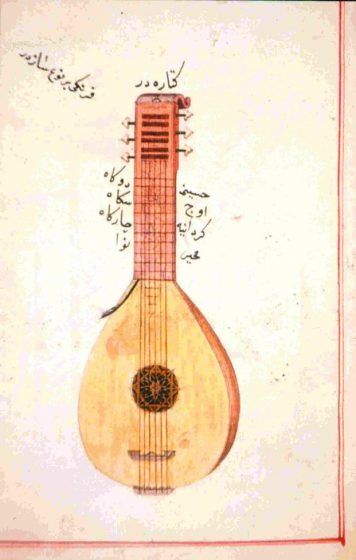
Al-Kindi (800-877 CE) wrote about music theory, including the scales (the mathematical intervals or divisions between notes). He wrote musical notation using letters, and described how to produce accurate scales on the lute, called ‘ud in Arabic, by arranging the frets (metal fingering bars on the neck of the instrument). Al-Kindi is said to have first used the Arabized word musiqi. Ibn Sina (b. 980 CE) also contributed to music theory based on Greek models and described various instruments, and as a physician he explored the effect of music on healing.
Arab mathematician and philosopher al-Farabi (870-950 CE) was known as a musician and scientist of music theory who wrote The Great Book of Music. Al-Farabi’s masterwork became influential among mathematicians and musicians for many centuries afterwards, including in Al-Andalus. Al-Farabi discussed musical scales and intervals and the concept of pitch and tuning instruments, among other innovations still being studied today.
Al-Farabi’s Great Book of Music was translated in Spain by Ibn Aqnin (1160-1226 CE), first into Hebrew, and then into Latin. Its titles in Latin, De Scientiis and De Ortu Scientiarum, show that music theory was considered a scientific discipline. Classical and Islamic ideas of music theory were very influential in the development of European music theory, though the transfer of knowledge from Arabic sources has not been sufficiently recognized.
Performance art and music theory came together in the royal courts of Al-Andalus throughout the period of Muslim rule. Ziryab whose real name was Abul-Hasan Alí Ibn Nafí, born in Iraq in 789 CE of North African heritage was a musician who represented the courtly arts and cultivated society. Al-Hakam, father of Abd-Al-Rahman II, invited him to court at Córdoba. Ziryab had studied music under a famous teacher in Baghdad, and he brought knowledge of music performance and knowledge to the Muslim lands of the west. He established a music conservatory in Córdoba that trained young musicians, spreading his influence to other courts.
Ziryab was probably the first to introduce the lute to Spain. He changed the way it was played by adding a fifth string and using an eagle’s talon instead of a wooden pick. His talent and influence included ideas about harmony, rhythm, and composition. Scholars of music history trace many later styles of song composition and performance to Ziryab. Certainly, his influence brought eastern styles as well as classical Greek and Arab musical ideas to Al-Andalus, but once there, they combined with North African and indigenous Iberian styles over time to create a distinctive Andalusian musical tradition that continued even after the end of Muslim rule on the Iberian Peninsula.
Written and pictorial evidence proves that a large number of musical instruments were used in Al-Andalus, whose origins lay in Asian, the Mediterranean, and African regional traditions. The mingling of cultures and the mobility brought about by trade, travel, and migration resulted in the transfer of many instruments and ways of performing with them. Literary evidence of musical instruments can be found in poetry, in the lyrics of songs, and on carved and painted artworks.
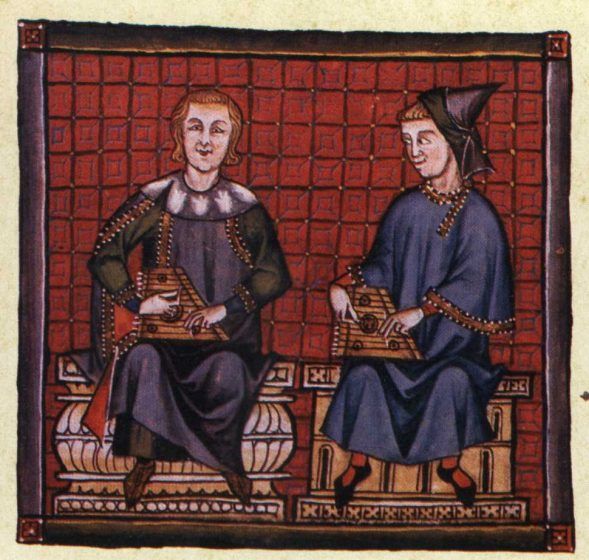
Among the works of translation and preservation of musical culture that were carried out after the conquest of Muslim cities, that of Alfonso X “the Wise” (1221-1284 CE) stands out. The Cantigas de Santa Maria is a set of illustrated Medieval manuscripts that forms one of the largest collections of songs from the Medieval period and tells much about the Andalusian legacy and about daily life, trade, and religious activities. The illustrations on these pages from the Cantigas show only a few of the instruments that experts attribute to the influence of Muslims in Al-Andalus.
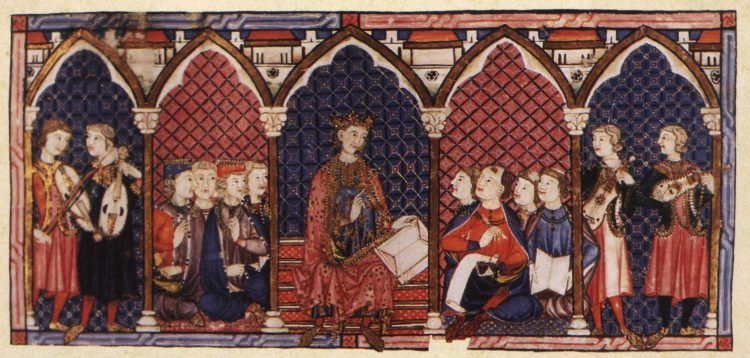
Many musical instruments that found their way into Spanish and then European musical traditions have Arabic names that are similar to their names in Spanish and other languages. Examples include: the guitar (Arabic: guitara or kaithaar); the lute (‘oud); and two stringed instruments, the rebec (Arabic: rabab) and the violin (Arabic: kamancha), all of which probably came from Central Asia originally but entered Europe through Spain.
Another famous instrument is the zither (Arabic: qanun), a stringed instrument with a wooden sound box played flat on a table or lap, which gave rise to the dulcimer, the harpsichord, and eventually the piano, but the zither is still played in its original form. Zitherlike instruments are found in many forms in Africa and Asia, differing in size, tuning, and number of strings.
Wind instruments like the flute and various horns are found in many cultures, but specific types seem to have transferred directly through Spain to Europe, including the bagpipe, which is shown in illustrations from the period. Bagpipes are also found in North Africa among nomadic herders, who often used leather bladders as wind chambers.
In addition to instrumental music and song, traditions of dance are often attributed to the influence of Al-Andalus. The most famous is the art of flamenco, but there are also many folk styles in Spain and Portugal that can be traced to the mingling of cultures there. Like cooking and clothing, music tends to move easily from place to place, and across language and religious barriers. It also tends to remain rooted in tradition despite the many changes and upheavals in the lives of the people who carry them from generation to generation.