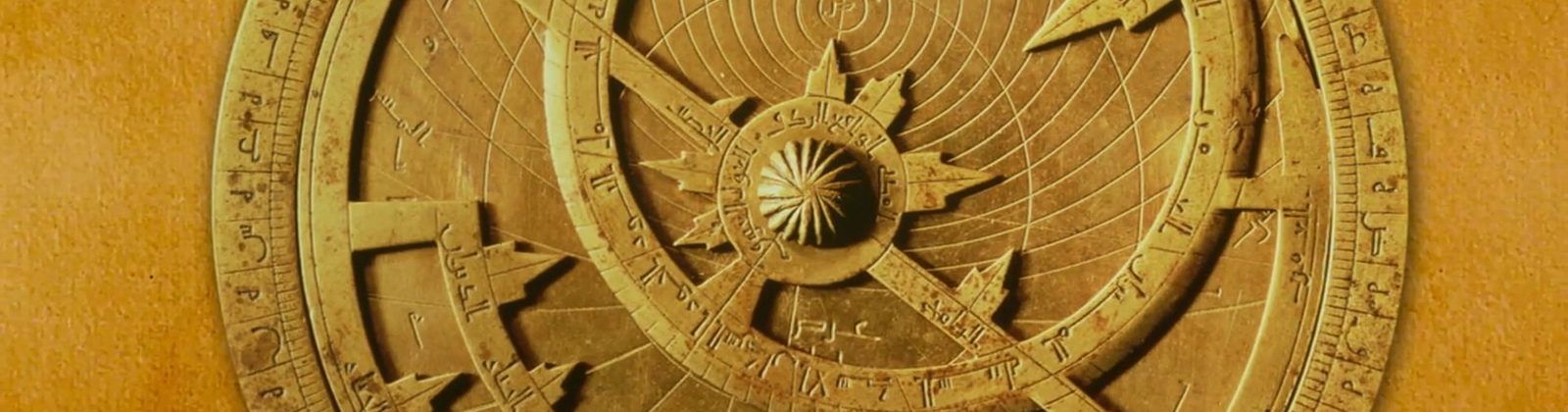
Physics is the science of motion and its laws, but also of sound, and light, and discussion of matter and energy. The modern science of physics grew out of many Medieval disciplines, ranging from philosophy, or speculative thought, to music theory, engineering, and optics — the study of light and vision, including mirrors, lenses, rainbows, shadows and the process of seeing. Experiments in flight and projection of objects in space (such as cannons, catapults and gliders) are also considered part of physics.
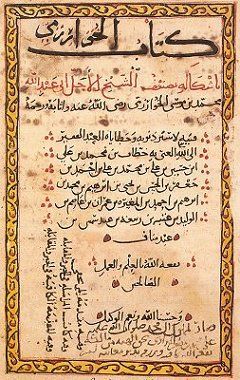
Achievements in Islamic Spain include new ideas produced by studies of physical science that were then published in books, and also translations of works from other Muslim lands, that were transferred to Europe and beyond. They include applications of physics to practical life in areas such as use of energy and hydraulic technologies.
Achievements in the physical sciences began at the court of Córdoba during the 9th and 10th centuries CE, where artists and scholars, inventors and writers could find patronage and interest in their ideas. Books from the eastern Muslim lands, especially Baghdad, were eagerly collected in Andalusian libraries of half a million volumes.
Among the works brought there were al-Khwarizmi’s mathematical writings. Like most other scholars of the time, al-Khwarizmi experimented with many ideas, such as calculating the thickness of earth’s atmosphere, and problems with optics, such as magnification. Works on sound and music theory were well known and put to practical use in building complex musical instruments.
Ibn al-Haytham (died ca. 1040 CE), known in Latin translation as Alhazen, was a scholar in Cairo whose work was widely translated into Latin during the 12th century CE and is still studied by historians of science today. Ibn al-Haytham described his experiments and investigations about light and vision in an innovative work called The Book of Optics. He analyzed the structure of the human eye and described how it sees. He overturned theories held since Aristotle and Ptolemy that either the eye sent out rays that allowed objects to be seen, or objects sent some force toward the eye.
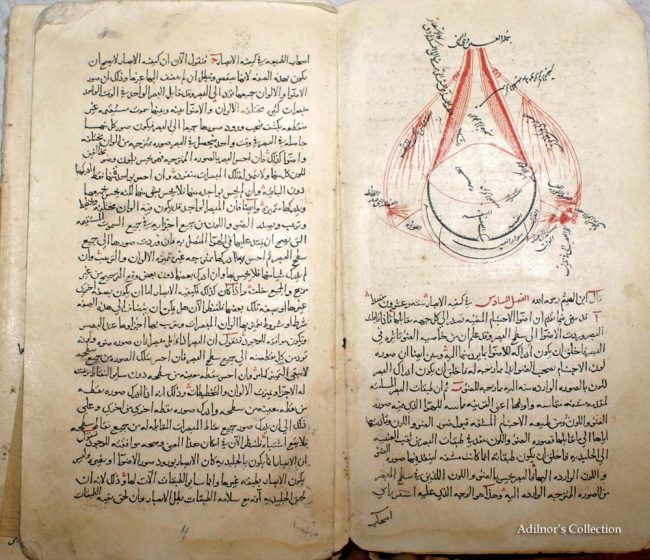
Ibn al-Haytham demonstrated how light enters the eye through the pupil. Using mathematical formulas, he described how light falling on the eye is refracted through its lens, allowing the eye to sense forms of light and color, and the mind to perceive and order the images. Other optical experiments and investigations included projecting the sun’s image on a wall through a small opening, which is the camera obscura similar to early photographic cameras of later centuries. (The light-sensitive film to capture the image was a much later invention.) He investigated mirror theory, described spherical and parabolic mirrors, calculated how light is refracted (bent), and how light passing through a lens is broken into the color spectrum — the rainbow. His investigation of glass and water lenses led to the creation of mathematical formulas that allowed advancements in refining the shape of lenses. European scholars studied these ideas, which led to lenses for telescopes, magnifying lenses, and eyeglasses.
Most surprisingly, his mathematical discussions of the way the eye sees led to the development of perspective drawing, a major aid to realistic painting, but also a great advancement in accurate illustration for scientific and technical books. Combined with the invention of printing, perspective drawing allowed accurate transmission of ideas for machines, architecture and other fields. Ibn Al-Haytham influenced important scientists such as Witelo, Kepler, and Roger Bacon, making Alhazen the most quoted physicist of the Medieval period.
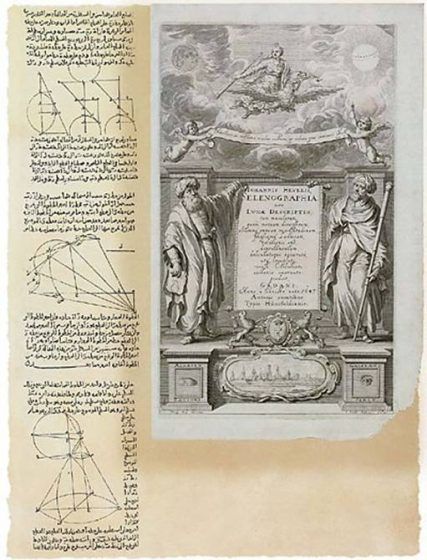
Although the achievements of Ibn al-Haytham, like those of other Muslim scientists, have been neglected, a 17th century engraving in a scientific book shows Galileo, inventor of the telescope and astronomer, dressed as an Arab and posing opposite him as a tribute to his contribution.
Other applications of physics were being used and developed in Al-Andalus. In hydraulic technology, machines to move water were built on models like those of al-Jazari, who invented the crank-connecting rod system. This was very important to the development of technology, because it involves a way of transforming rotation into linear motion, like the mechanism that moves your bicycle. The same principle is used in car engines.
Al-Jazari’s manuscript is full of innovations, such as valves and pistons, one of the first mechanical clocks driven by water and weights, and a combination lock. Andalusian Muslim engineers continued to produce and perfect mechanical clocks, and this knowledge was transmitted to Europe through Latin translations of their books on mechanics. Many of these books have since been lost or destroyed.
Another practical and experimental scientist who worked in Al-Andalus was as Abbas ibn Firnas (810–887 CE), who came to Córdoba from Baghdad to teach music theory at the court of Abd al-Rahman III. Ibn Firnas worked in many fields, including chemistry, physics, astronomy, and as a poet. He designed a water clock, he worked to improve the way glass was made, and is said to have worked on eyeglasses to help those with poor vision. He devised a way to cut very hard quartz, or rock crystal, and made a mechanical model to show the motions of planets and stars.
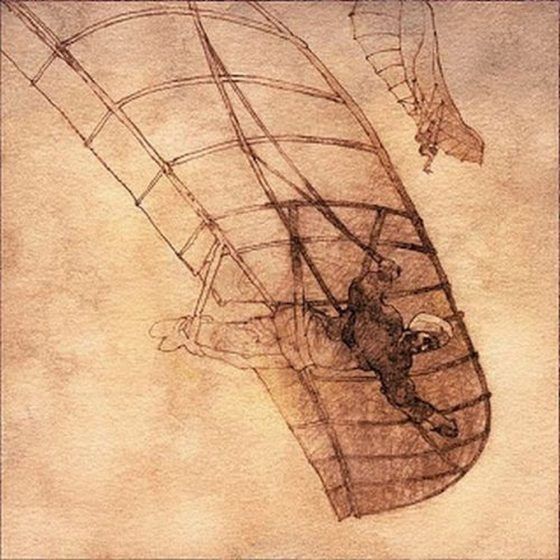
In 875 CE, Ibn Firnas did something that made him famous, but almost ended his career. He constructed a glider, and launched himself into the air. The flight was successful, and was viewed by a crowd of invited guests. As an experimental vehicle, however, the design was not perfected, and it had no tail to help with landing, a fact which he later noted when observing birds. He injured his back upon landing. Historian Philip Hitti wrote, “Ibn Firnas was the first man in history to make a scientific attempt at flying.” A crater on the map of the moon is named Ibn Firnas to honor his achievement as one of the first people to fly.
Europeans benefited greatly from the knowledge and research of Muslims in physics. One piece of evidence of this is that many these books were translated into Latin in Spain. Another is that these books were taught in European universities and quoted by scientists as they developed their own work. Finally, they were among the first books printed after Gutenberg invented the printing press in 1453 CE by, and were re-printed many times. These ideas laid the foundation for the Scientific Revolution of the 16th and 17th centuries CE. Even though much of this Muslim legacy was forgotten, historians of science are restoring its rightful place today.