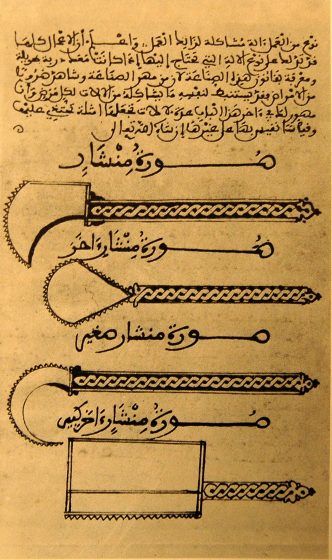
The most famous surgeon in Al-Andalus was the 10th century physician and author, Abul Qasim Khalaf Ibn Al-Abbas Al-Zahrawi (936-1013 CE). Al-Zahrawi was known to Europeans in Latin as Albucasis, and his surgical work was translated and widely used, being printed and used in medical schools even centuries later. The text at right shows illustrations of metal surgical instruments. It was translated at Toledo by the famous translator Gerard of Cremona.
Al-Zahrawi described many surgical cures for diseases, designed instruments, and wrote about techniques surgeons should use. He discussed cauterization (cleaning and sealing wounds by burning), closing wounds with sutures (stitches), bloodletting and bone-setting, and the proper way to conduct amputations when necessary. He was a pioneer in surgery for the eye, ear, and throat, including a device for cutting out infected tonsils that caught the tonsil in a basket so that it would not fall down the throat of the patient. He also wrote about midwifery and obstetrics — aiding women in childbirth.
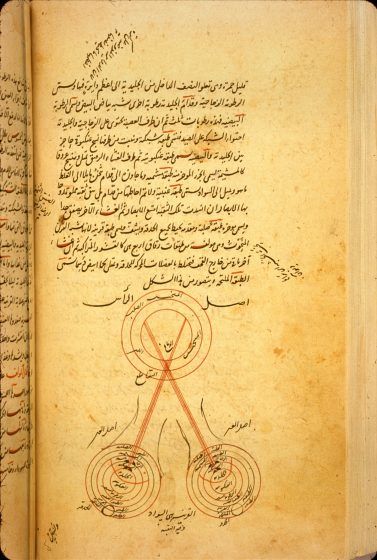
His instruments were designed to be efficient, specialized for particular types of surgery, and helpful in preventing patients from being frightened. For example, he designed a hidden knife for opening infected wounds so that frightened patients would not see it.
There is evidence that Muslim surgeons used anesthetics, both in the form of pain-killers given by mouth, and a sponge soaked with substances that were placed under the nose of the patient to make him or her less sensitive to pain. Otherwise, surgery was an ordeal that often required the patient to be held steady by more than one person.