Article: Ziryab, Poet of Cordoba
Learn about Ziryab, the famous Cordoban poet of Islamic Spain, in this overview of his remarkable life that influenced the art and culture of Spain and North Africa that we see (and hear) today.
Written by Robert W. Lebling Jr.
Illustrated by Norman MacDonald
If you eat asparagus, or if you start your meal with soup and end with dessert, or if you use toothpaste, or if you wear your hair in bangs, you owe a lot to one of the greatest musicians in history.
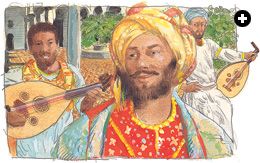
He was known as Ziryab, a colloquial Arabic term that translates as “blackbird.” He lived in Medieval Spain more than a thousand years ago. He was a freed slave who made good, charming the royal court at Córdoba with his songs. He founded a music school whose fame survived more than 500 years after his death. Ibn Hayyan of Córdoba, one of Arab Spain’s greatest historians, says in his monumental Al-Muqtabas or The Citation that Ziryab knew thousands of songs by heart and revolutionized the design of the musical instrument that became the lute. He spread a new musical style around the Mediterranean, influencing troubadours and minstrels and affecting the course of European music.
He was also his generation’s arbiter of taste, style and manners, and he exerted enormous influence on Medieval European society. How people dressed, what and how they ate, how they groomed themselves, what music they enjoyed all were influenced by Ziryab.
If you’ve never heard of this remarkable artist, it’s not surprising. With the twists and turns of history, his name has dropped from public memory in the Western world. But the changes he brought to Europe are very much a part of the reality we know today.
One reason Ziryab is unknown to us is that he spoke Arabic, and was part of the royal court of the Arab empire in Spain. Muslims from Arabia and North Africa ruled part of Spain from 711 until 1492. The last remnant of Arab rule in the Iberian Peninsula, the Kingdom of Granada, was conquered by the armies of King Ferdinand and Queen Isabella in the same year that Columbus sailed for the New World.
The Arabs called their Iberian domain Al-Andalus a direct reference to the Vandals, who occupied the peninsula in the fifth century and whose legacy was still pervasive when Muslim forces arrived in the eighth. That name survives today in the name of Spain’s southern province, Andalusia. At its peak, Al-Andalus experienced a golden age of civilization that was the envy of all Europe, and which set the stage for the European Renaissance that followed. Muslims, Christians, and Jews interacted in a convivencia a “living-together” of tolerance and cooperation unparalleled in its time. Influences from Arab Spain spread to France and throughout Europe, and from there to the Americas. It was in this context that the achievements of Ziryab became part of western culture.
Ziryab’s achievements were not forgotten in the Arab world, and it is from historians there that we know of his life and accomplishments. As the 17th-century Arab historian al-Maqqari says in his Nafb al-Tib or Fragrant Breeze, “There never was, either before or after him, a man of his profession who was more generally beloved and admired.”
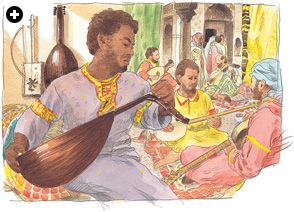
Ziryab, the famed poet of Islamic Spain, was actually named Abu al-Hasan ‘Ali ibn Nafi’ and was born in about the year 789 in the land now called Iraq, perhaps in its capital, Baghdad. Some Arab historians say he was a freed slave apparently a page or personal servant whose family had served al-Mahdi, the caliph or ruler of the Baghdad-based Abbasid empire from 775 until his death in 785. In those days, many prominent musicians were slaves or freedmen, some of African origin, others from Europe or the Middle East (including Kurdistan and Persia). Historians differ over whether Ziryab was African, Persian or Kurdish. According to Ibn Hayyan, ‘Ali Ibn Nafi’ was called Blackbird because of his extremely dark complexion, the clarity of his voice and “the sweetness of his character.”
Blackbird studied music under the famous singer and royal court musician Ishaq al-Mawsili or Isaac of Mosul. Ishaq, his even more celebrated father, Ibrahim, and Ziryab are the three artists known as the fathers of Arabic music.
Baghdad was then a world center for culture, art and science. Its most famous ruler was Harun al-Rashid, who succeeded al-Mahdi. Harun was a lover of music, and brought many singers and musicians to the palace for the entertainment of his guests. Ishaq, as Harun’s chief musician, trained a number of students in the musical arts, among them Blackbird. Ziryab was intelligent and had a good ear; outside his lessons, he surreptitiously learned the songs of his master, which were said to have been complex and difficult even for an expert. Ishaq did not realize how much Ziryab had learned until Harun himself asked to hear the young musician.
In Ibn Hayyan’s account (as related by al-Maqqari), Ishaq told the caliph, “Yes, I’ve heard some nice things from Ziryab, some clear and emotional melodies particularly some of my own rather unusual renditions. I taught him those songs because I considered them especially suited to his skill.”
Ziryab was summoned, and he sang for Harun al-Rashid. Afterward, when the caliph spoke to him, Ziryab answered “gracefully, with real charm of manner.” Harun asked him about his skill, and Blackbird replied, “I can sing what the other singers know, but most of my repertory is made up of songs suitable only to be performed before a caliph like Your Majesty. The other singers don’t know those numbers. If Your Majesty permits, I’ll sing for you what human ears have never heard before.”
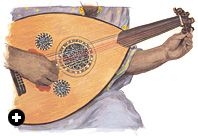
Harun raised his eyebrows, and ordered that master Ishaq’s lute be handed to Ziryab. The Arabian lute or ‘ud, model of the European lute and relative of the guitar, was an instrument with four courses of strings, a body shaped like half a pear, and a bent, fretless neck.
Ziryab respectfully declined the instrument. “I’ve brought my own lute,” he said, “Which I made myself, stripping the wood and working it, and no other instrument satisfies me. I left it at the palace gate and, with your permission, I’ll send for it.”
Harun sent for the lute and he examined it. It looked like Ishaq al-Mawsuli’s instrument “Why won’t you play your master’s lute?” the caliph asked.
“If the caliph wants me to sing in my master’s style, I’ll use his lute. But to sing in my own style, I need this instrument.”
“They look alike to me,” Harun said.
“At first glance, yes,” said Ziryab, “But even though the wood and the size are the same, the weight is not. My lute weighs about a third less than Ishaq’s, and my strings are made of silk that has not been spun with hot water which weakens them. The bass and third strings are made of lion gut, which is softer and more sonorous than that of any other animal. These strings are stronger than any others, and they can better withstand the striking of the pick.”
Ziryab’s pick was a sharpened eagle’s claw, rather than the usual piece of carved wood. He had also, added a fifth course of strings to the instrument.
Harun was satisfied. He ordered Ziryab to perform, and the young man began a song he had composed himself. The caliph was quite impressed. He turned to al-Mawsuli and said, “If I thought you had been hiding this man’s extraordinary ability, I’d punish you for not telling me about him. Continue his instruction until it’s completed. For my part, I want to contribute to his development.”
Ziryab had apparently concealed his finest talents from his own teacher. When Ishaq was finally alone with his pupil, he raged about being deceived. He said frankly that he was jealous of Ziryab’s skill, and feared the pupil would soon replace the master in the caliph’s favor.
“I could pardon this in no man, not even my own son,” Ishaq said. “If I weren’t still somewhat fond of you, I wouldn’t hesitate to kill you, regardless of the consequences. Here is your choice: Leave Baghdad, take up residence far from here, and swear that I’ll never hear from you again. If you do this, I’ll give you enough money to meet your needs. But if you choose to stay and spite me I warn you, I’ll risk my life and all I possess to crush you. Make your choice!”
Ziryab did not hesitate; he took the money and left the Abbasid capital. Ishaq explained his protégé’s absence by claiming that Ziryab was mentally unbalanced and had left Baghdad in a rage at not receiving a gift from the caliph. “The young man is possessed,” Ishaq told Harun al-Rashid. “He’s subject to fits of frenzy that are horrible to witness. He believes the jinn speak with him and inspire his music. He’s so vain he believes his talent is unequaled in the world. I don’t know where he is now. Be thankful, Your Majesty, that he’s gone.”
There was a germ of truth in Ishaq’s tale: According to Ibn Hayyan and others, Ziryab did believe that in his dreams he heard the songs of the jinn, the spirit beings of Islamic and Arab lore. He would wake from a dream in the middle of the night and summon his own students, teaching them the melodies he had heard in his dreams.
As Reinhart Dozy notes in Histoire des Musulmans d’Espagne, “None knew better than Ishaq that there was no insanity in all this. What true artist, indeed, whether believing in jinn or not, has not known moments when he has been under the sway of emotions hard to define, and savoring of the supernatural?”
Ziryab and his family fled from Baghdad to Egypt and crossed North Africa to Kairouan in present-day Tunisia, seat of the Aghlabid dynasty of Ziyadat Allah I. There he was welcomed by the royal court. But he had no intention of staying in Kairouan; his eyes were on Spain. Under the Umayyads, Córdoba was fast becoming a cultural jewel to rival Baghdad, and Blackbird thought Córdoba might be a fit setting for his talents.
Ziryab wrote to al-Hakam, ruler of the emirate of Al-Andalus, and offered his musical skills. Al-Hakam, delighted with the prospect of adding a Baghdad musician to his court, wrote back inviting Ziryab to proceed to Córdoba. He offered the musician a handsome salary. Ziryab and his family packed their bags and headed overland to the Strait of Gibraltar, where they embarked on a ship bound for Algeciras, Spain.
When Ziryab arrived in Spain in the year 822, he was shocked to learn that al-Hakam was dead. Devastated, the young musician prepared to return to North Africa. But thanks to the glowing recommendation of Abu al-Nasr Mansur, a Jewish musician of the Córdoban royal court, al-Hakam’s son and successor ‘Abd al-Rahman II renewed the invitation to Ziryab.
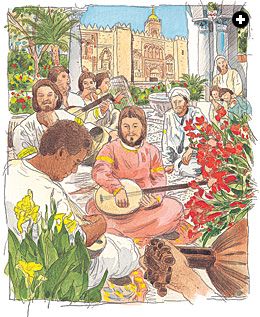
After meeting with the 33-year-old wonder from Baghdad, ‘Abd al-Rahman who was about the same age made him an attractive offer. Ziryab would receive a handsome salary of 200 gold pieces per month, with bonuses of 500 gold pieces at midsummer and the new year and 1000 on each of the two major Islamic holidays. He would be given 200 bushels of barley and 100 bushels of wheat each year. He would receive a modest palace in Córdoba and several villas with productive farmland in the countryside. Naturally, Ziryab accepted the offer; overnight he became a prosperous member of the landed upper class in Islamic Spain.
Abd al-Rahman’s objective in hiring the young musician was to bring culture and refinement to the rough-and-ready country of Al-Andalus, the wild west of the Arab world and not too long ago a “barbarian” Gothic land far from the civilized centers of Damascus and Baghdad. The ruler’s own Umayyad family had come as exiles from Damascus, where they had ruled an Islamic empire for several hundred years. Now the power rested with the Abbasids in Baghdad, and that city had become a magnet for scientists, artists and scholars of all descriptions.
In fact, ‘Abd al-Rahman offered Ziryab employment before even asking him to perform. And when he eventually did hear Ziryab’s songs, contemporaries say the ruler was so captivated that he would never again listen to another singer. From that day forward, ‘Abd al-Rahman and Ziryab were close confidants, and would often meet to discuss poetry, history, and all the arts and sciences.
Ziryab served as a kind of minister of culture for the Andalusi realm. One of his first projects was to found a school of music, which opened its doors not only to the talented sons and daughters of the higher classes but also to lower-class court entertainers. Unlike the more rigid conservatories of Baghdad, Ziryab’s school encouraged experimentation in musical styles and instruments. While the academy taught the world-famous styles and songs of the Baghdad court, Ziryab quickly began introducing his innovations and established his reputation as, in the words of the Encyclopaedia of Islam, “the founder of the musical traditions of Islamic Spain.”
He created the rules governing the performance of the nuba (or nauba), an important Andalusian Arab music form that survives today in the classical music of North Africa, known as maluf in Libya, Tunisia and eastern Algeria, and simply as andalusi music farther west. Ziryab created 24 nubas, one for each hour of the day, like the classical ragas of India. The nuba form became very popular in the Spanish Christian community and had a pronounced influence on the development of Medieval European music.
Adding a fifth pair of strings to the lute gave the instrument greater delicacy of expression and a greater range. As music historian Julian Ribera wrote in the 1920’s, the Medieval lute’s four courses of strings were widely believed to correspond to the four humors of the body. The first pair was yellow, symbolizing bile; the second was red for blood; the third white for phlegm; and the fourth, the bass pair, was black for melancholy. Ziryab, it was said, gave the lute a soul, adding another red pair of strings between the second and third courses.
Ziryab heightened the lute’s sensitivity by playing the instrument with a flexible eagle’s talon or quill, rather than the traditional wooden pick. This innovation spread quickly, and soon no skilled musician in Córdoba would consider touching wood to the strings of his lute.
Ziryab reputedly knew the words and melodies of 10,000 songs by heart. Though this claim is probably exaggerated, his memory was certainly prodigious. He was also an excellent poet, a student of astronomy and geography, and a dazzling conversationalist, according to Ibn Hayyan and al-Maqqari. He often discussed the customs and manners of nations throughout the known world, and he spoke extensively of the high civilization centered in Baghdad. As his popularity in Al-Andalus grew, so did his influence. His suggestions and recommendations became the popular fashion. Many of his new ideas gradually migrated into the land of the Franks. France, Germany, northern Italy and beyond.
Ziryab loved well-prepared food almost as much as he did music. He revolutionized the arts of the table in Spain, in ways that survive to this day.
Before Ziryab, Spanish dining was a simple, even crude, affair, inherited from the Visigoths, the successors of the Vandals, and from local custom. Platters of different foods were piled together, all at the same time, on bare wooden tables. Table manners were nonexistent.
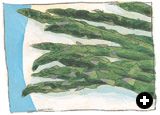
A wide array of foods was available in Al-Andalus meats, fish and fowl, vegetables, cheeses, soups and sweets. Ziryab combined them in imaginative recipes, many originating in Baghdad. One of these dishes, consisting of meatballs and small triangular pieces of dough fried in coriander oil, came to be known as taqliyat Ziryab, or Ziryab’s fried dish; many others bore his name as well. He delighted court diners by elevating a humble spring weed called asparagus to the status of a dinner vegetable. Ziryab developed a number of delectable desserts, including an unforgettable treat of walnuts and honey that is served to this day in the city of Zaragoza. In his adopted home, Córdoba, the musician-gourmet is remembered today in an old dish of roasted and salted broad beans called ziriabí.
The staying power of Blackbird’s reputation is such that even today in Algeria, where Andalusi influence continues to echo, the sweet orange Arab pastry known as zalabia here it takes the form of a spiral of fried batter soaked in saffron syrup is believed by many Algerians to derive its name from Ziryab, a claim impossible to confirm or refute. An Indian version of zalabia, the jalebi, can be traced back to the 15th century within India but no earlier, and it could be a borrowing from the Arabs and ultimately from Ziryab.
With the emir’s blessing, Ziryab decreed that palace dinners would be served in courses according to a fixed sequence, starting with soups or broths, continuing with fish, fowl or meats, and concluding with fruits, sweet desserts and bowls of pistachios and other nuts. This presentation style, unheard of even in Baghdad or Damascus, steadily gained in popularity, spreading through the upper and merchant classes, then among Christians and Jews, and even to the peasantry. Eventually the custom became the rule throughout Europe. The English expression “from soup to nuts,” indicating a lavish, multi-course meal, can be traced back to Ziryab’s innovations at the Andalusi table.
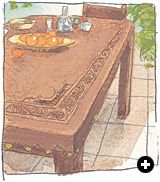
Dressing up the plain wooden dinner table, Ziryab taught local craftsmen how to produce tooled and fitted leather table coverings. He replaced the heavy gold and silver drinking goblets of the upper classes a holdover from the Goths and Romans with delicate, finely crafted crystal. He redesigned the bulky wooden soup spoon, substituting a trimmer, lighter model.
Ziryab also turned his attention to personal grooming and fashion. He developed Europe’s first toothpaste (though what exactly its ingredients were, we cannot say). He popularized shaving among men and set new haircut trends. Before Ziryab, royalty and nobles washed their clothes with rose water; to improve the cleaning process, he introduced the use of salt.
For women, Blackbird opened a beauty parlor/cosmetology school not far from the Alcazar, the emir’s palace. He created hairstyles that were daring for the time. The women of Spain traditionally wore their hair parted in the middle and covering their ears, with a long braid down the back. Ziryab introduced a shorter, shaped cut, with bangs on the forehead and the ears uncovered. He taught the shaping of eyebrows and the use of depilatories for removing body hair. He introduced new perfumes and cosmetics. Some of Ziryab’s fashion tips were borrowed from the elite social circles of Baghdad, then the world’s most cosmopolitan city. Others were twists on local Andalusi custom. Most became widespread simply because Ziryab advocated them; he was a celebrity, and people gained status simply by emulating him.
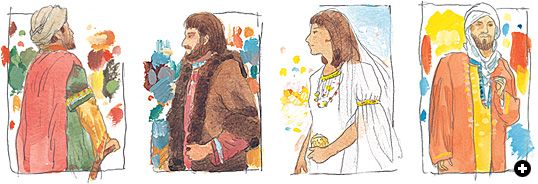
As an arbiter of courtly dress, he decreed Spain’s first seasonal fashion calendar. In springtime, men and women were to wear bright colors in their cotton and linen tunics, shirts, blouses and gowns. Ziryab introduced colorful silk clothing to supplement traditional fabrics. In summer, white clothing was the rule. When the weather turned cold, Ziryab recommended long cloaks trimmed with fur, which became all the rage in Al-Andalus.
Ziryab exercised great clout at the emir’s court, even in political and administrative decision-making. ‘Abd al-Rahman II has been credited with organizing the “norms of the state” in Al-Andalus, transforming it from a Roman-Visigothic model to one set up along Abbasid lines. Ziryab is said to have played a significant role in this process.
Ziryab brought in astrologers from India and Jewish doctors from North Africa and Iraq. The astrologers were grounded in astronomy, and Ziryab encouraged the spread of this knowledge. The Indians also knew how to play chess, and Ziryab had them teach the game to members of the royal court, and from there it spread throughout the peninsula.

Not surprisingly, Ziryab’s all-encompassing influence incurred the jealousy and resentment of other courtiers in Córdoba. Two celebrated poets of the day, Ibn Habib and al-Ghazzal, wrote scathing verses attacking him. Al-Ghazzal, a prominent Andalusi satirist, probably viewed the Baghdadi Ziryab as a high-toned interloper. Ziryab maintained the friendship and support of the emir, however, and that was all that mattered.
Abd al-Rahman II died in about 852, and his remarkable innovator Ziryab is believed to have followed about five years later. Ziryab’s children kept alive his musical inventions, assuring their spread throughout Europe. Each of his eight sons and two daughters eventually pursued a musical career, though not all became celebrities. The most popular singer was Ziryab’s son ‘Ubayd Allah, though his brother Qasim was said to have a better voice. Next in talent was ‘Abd al-Rahman, the first of the children to take over the music school after their father’s death, but arrogance was said to be his downfall, for he ended up alienating everyone, according to Ibn Hayyan.
Ziryab’s daughters were skilled musicians. The better artist was Hamduna, whose fame translated into marriage with the vizier of the realm. The better teacher was her sister ‘Ulaiya, the last survivor among Ziryab’s children, who went on to inherit most of her father’s musical clients.
As ‘Abd al-Rahman II and Ziryab departed the stage, Córdoba was coming into its own as a cultural capital and seat of learning. By the time another ‘Abd al-Rahman, the third, took power in 912, the city had become the intellectual center of Europe. As historian James Cleugh said of Córdoba in Spain in the Modern World, “there was nothing like it, at that epoch, in the rest of Europe. The best minds in that continent looked to Spain for everything which most clearly differentiates a human being from a tiger.”
As the first millennium drew to a close, students from France, England, and the rest of Europe flocked to Córdoba to study science, medicine, and philosophy and to take advantage of the great municipal library, with its 600,000 volumes. When they returned to their home countries, they took with them not only knowledge, but also art, music, cuisine, fashion, and manners.
Europe found itself awash with new ideas and new customs, and among the many streams that flowed northward from the Iberian Peninsula, more than one had been channeled by Ziryab.
Robert W. Lebling, Jr. is head of electronic publishing for Saudi Aramco in Dhahran. His academic background includes studies in the history, politics and anthropology of Arab North Africa and Al-Andalus. He is collaborating on a book on natural remedies of Arabia.
Norman MacDonald is a Canadian free-lance illustrator who lives in Amsterdam. He has been sketching the war-crimes trial of former Yugoslav president Slobodan Milosevic in The Hague.
Learn more about Ziryab, the famous poet of Islamic Spain, here!