The cities and towns of Al-Andalus dotted its tapestry of farmland like brilliant pearls. Among these were the key cities of Córdoba, Granada, Madrid, Seville, and Toledo.
Each of these cities played an important role in shaping and sustaining the common culture of Al-Andalus. Córdoba served as the political center of Al-Andalus for many centuries. Madrid and Toledo were vibrant frontier cities. Seville played a key role in the agricultural vitality of Islamic Spain. And, Granada witnessed the rise and fall of Muslim rule in Iberia.
Explore architectural achievements of Islamic Spain in an interactive map here.
Córdoba (Qurtubah)
During the Roman Empire, Córdoba served as a provincial capital. The city maintained its importance during the Visigothic era in the 5th century. After the Muslim conquest of Iberia in 711, the Umayyad amirs (leaders) established Córdoba as the capital of Al-Andalus.
One of these Umayyad leaders was Abd al-Rahman I. Under his rule, the city acquired a reputation for splendor and refinement that rivaled Baghdad in the east. Scholars of all faiths flocked to Córdoba to take part in scientific ventures patronized by the rulers. This cultural burgeoning continued under the rule of his descendants.
By the 10th century during caliph Abd al-Rahman III‘s reign, Córdoba distinguished itself as the most advanced city in Europe. Dwellers enjoyed running water in private homes, paved streets, streetlights, lush gardens, and a rich bounty of foods, medicines, clothing, and crafts.
By this time, the city’s population exceeded half a million inhabitants. The city included numerous suburbs, hundreds of mosques, public baths, suqs (markets), mills, and palaces.
In the early 11th century, the caliphate crumbled amid economic and military pressures. This downturn led to the rise of smaller kingdoms, called taifas. Yet, the rulers of these petty kingdoms continued to emulate the Córdoba’s opulence.
Today, Córdoba is a medium-sized city with about 300,000 inhabitants. The picturesque old portion of the city remains intact.
The Jewish quarter, known as the juderia, features white-washed, tile-roofed patio homes typical of the region.
The Great Mosque of Córdoba — which is now a UNESCO World Heritage Site — is one of the major monuments in the world. It boasts beautiful rows of columns and arches made of red and white stone.
A few kilometers outside the city, the excavated ruins of the Umayyad caliphal palace, known as Madinat al-Zahra, reveals the luxurious lifestyle of the elite.
Modern-day Córdoba boasts statues of Maimonides and Ibn Rushd to honor the city’s native sons. There are also frequent musical and cultural festivals to celebrate the legacies of Islamic Spain.
Granada (Gharnatah)
Granada became a prominent city during the era of the petty kingdoms (taifas). After the caliphate’s end in the 11th century, an Amazigh (Berber) tribe — known as the Zirids — relocated from Córdoba to establish an independent kingdom and founded Granada.
Jews and Muslims emigrated from the nearby city of Elvira to Granada. At the time, Iberian Jews mainly inhabited the area. These Muslim immigrants began developing a city at the base of the Sierra Nevada Mountains. In the mid-13th century, Ferdinand III marched on many cities, including Muslim-ruled Seville and Córdoba. To prevent the Christian king’s imminent invasion, Granada ruler Muhammad Ibn Ahmar made a treaty. It required Ibn Ahmar to pay an annual tribute and assist Fernando on military campaigns.
Ibn Ahmar and his descendants, known as the Nasrid dynasty, ruled the kingdom of Granada for several centuries. Throughout their reign, Muslim and Jewish refugees — from cities conquered by Christians — flocked to Granada. This land was the last remaining Muslim kingdom on the peninsula. In 1492, Isabella and Ferdinand forced the last Muslim ruler, Boabdil, to surrender the city.
This strategic move signaled the end of Al-Andalus. Most Muslims — who chose to remain in Granada, rather than immigrate to North Africa — eventually assimilated to Catholicism as Moriscos and Marranos. Then, Christians from the north began to populate the south.
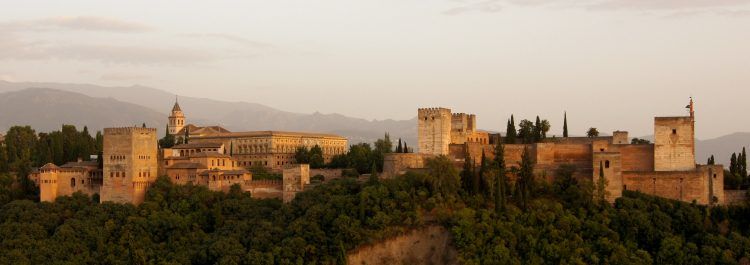
In the 18th and 19th centuries, the city expanded. Today, Granada’s metropolitan population reaches about 500,000.
Portions of the old Muslim city still remain. One particular area, known as the albaicín, features narrow cobblestone streets, teterías (cafes), and handicrafts. This area remains popular with tourists.
The largest tourist attraction is the Alhambra. The Nasrid rulers built this vast palace complex on a hill overlooking the city of Granada. The palace’s gardens, fountains, and courtyards attract over 6 million visitors each year, making it one of the most visited historical sites in all of Europe.
Madrid (al-Majreet)
Madrid is a cosmopolitan city located in central Spain and serves as its capital today. About 3.5 million people in Madrid’s metropolitan area.
Archeological evidence reveals that a Roman settlement existed in the 2nd century BCE on the banks of the Manzanares River. But, the city’s first textual references in the 9th century CE describe Madrid as an Umayyad-administered frontier town at the northern edge of Al-Andalus.
The modern name “Madrid” most likely derives from the Arabic al-majreet, which means “the water channel.” The term refers to the new irrigation techniques used by Muslims in the dry meseta (high plain) lands.
In 1085 CE, Alfonso VI of Castile conquered al-Majreet en route to Toledo, where he sought to extend his control. In 1561, the city became Spain’s capital.
During the 18th century, Madrid adopted a more European quality, when Spain enjoyed its peak as a world power. Later that century, Madrid and other cities suffered a major intellectual and political crisis, resulting from the loss of colonial territories. This downturn culminated in The Spanish-American War of 1898 and the Spanish Civil War of 1936-39.
Spain integrated into the European Union following the Franco era in 1975. Since then, Madrid has played an increasingly important role in European and international affairs.
Today, Madrid hosts a perse cultural and educational program called El Legado Andalusi, to honor Spain’s Islamic heritage and promote tourism. The central government in Madrid — along with the regional government of Andalucía — initiated this program following the 1992 Universal Exposition in Seville. Corporations, academic bodies, and civic groups also support the initiative.
Seville (Ishbiliyah)
In Roman times, Seville was known as the port city, Hispalis. Located along the Guadalquivir River, Seville enjoyed direct access downriver to the Atlantic Ocean. Later, Phoenicians and Carthaginians controlled the city before becoming part of the Visigothic kingdom.
During the Muslim era, Seville earned prominence. It served as the Almoravid and Almohad capital in Spain. Seville often competed with Córdoba as a center of learning and wealth. After Vikings attacked the city in the mid-9th century, the Umayyad amir Abd al-Rahman II built a naval fleet and series of watchtowers to protect his realm. During the era of the petty kingdoms, Seville became a shining city under the poet-king al-Mutamid.
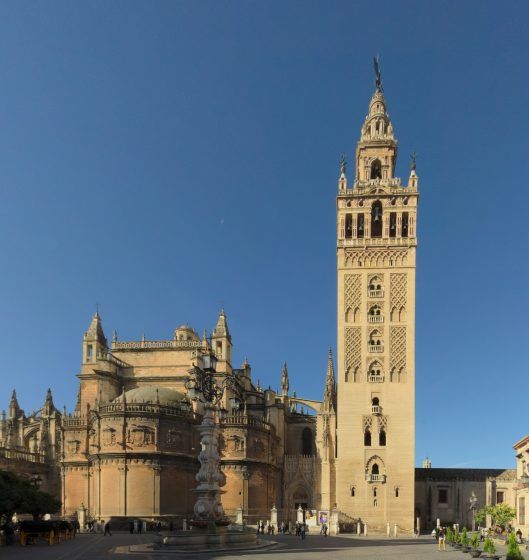
Fernando III of Castile, who prized the city, conquered it in 1248. Legend says he rode his steed up the ramps inside La Giralda — the 320-ft. tall minaret of Seville’s large congregational mosque — to proclaim his victory.
In the 16th to 18th centuries, the Spaniards transported silver acquired from the New World on ships landing in Seville. The city also maintained all records of Spanish administration in the Americas, called the “Archive of the Indias.”
In 1992, Seville hosted the Universal Exposition. This major event signaled Spain’s resurgence as a democratic, cosmopolitan European nation.
Today, Seville is the artistic, cultural, and financial capital of southern Spain. It is the fourth largest metropolitan area in Spain, with a population of about 1.3 million.
Toledo (Tulaytulah)
Toledo is located 42 miles (70 km) southwest of Madrid, on a large hill that juts up from the meseta (high plain) in the La Mancha region. It is surrounded on three sides by the Tajo river, serving as a natural fortress.
Since Roman times, Toledo served as a strategic location on the road from Emerita (modern Mérida in the southwest), to Caesar-Augusta (modern Zaragoza in the northeast). The city became the capital of the Visigoths. They ruled Iberia from about 510 CE until the Muslim conquest in 711.
Toledo served as the seat of the Spanish Church, from the Visigothic era until the 16th century. The city hosted numerous church councils, where they debated doctrines and heresies. There were also two major synagogues built: Santa María La Blanca and del Tránsito. Santa María (pictured left) features a Mudejar-style construction and was built in the 12th century. Decorated with Mudejar elements, geometric and floral motifs, and Arabic and Hebrew inscriptions, del Tránsito was built in the 14th century.
Toledo remained a key Andalusi city during the height of Muslim power under the Umayyads. When Toledo surrendered to Christian forces under Alfonso VI in 1085 during the petty kingdom (taifa) era, it proved a fatal blow to the Muslims.
This loss prompted Seville and Granada’s Muslim kings to appeal to North Africa’s Amazigh (Berber) Almoravids for support against Christian forces. In subsequent centuries, the two cities would ultimately succumb to Christian rule.
During the 13th century, the Christian ruler Alfonso X established a translation center in Toledo. Here, Arabic works of astronomy, mathematics, medicine, botany, and other fields were rendered into Latin. Toledo became one of the major points of intellectual transmission from Islamic civilization to Europe, sowing the seeds for the Renaissance.
Today, Toledo is known for its mazapan (marzipan), a pastry made with sugar, eggs and almonds. Persian immigrants introduced this delectable delight to Al-Andalus.
Toledo also has long been famed for its metalwork, particularly steel blades and other arms. Expert craftsmen produce these items in a style clearly reflecting Islamic origins.
Jewelry and other articles of gold and black metal are called damasquinos. The term refers to the Syrian city of Damascus. The Umayyads came from Damascus to establish their rule in Iberia.
Toledo features a quaint Medieval quality, with narrow cobblestone streets and a variety of handicrafts. It has a population of about 75,000 inhabitants. In 1986, UNESCO designated the city as a World Heritage Site for its extensive cultural and monumental heritage.